
Last updated 1 October 2026 · Fremont Math Hub
Short answer: for most self-studiers, the best starting point is Khan Academy — it’s completely free, covers K-12 through early college, and diagnoses the gaps holding you back. If you want university-level depth, choose edX or Coursera; if you are training for competitions, choose Art of Problem Solving. The comparison below shows what each one costs, what it teaches, and who it suits.

Which online math course should you choose?
All ten options below are genuinely usable for self-study. They differ in three ways that matter: whether they are free, whether they teach through video or through problems, and how far up the curriculum they go.
| Course | Price | Format | Best for |
|---|---|---|---|
| Khan Academy | Free | Video + adaptive practice | Filling gaps, K-12 to early college |
| edX | Free to audit; verified certificates from about $50 | University courses | Rigorous university-level material |
| Coursera | Free to audit; Coursera Plus $59/month or $399/year | University courses + certificates | Learners who want a credential |
| Brilliant | From about $22.50/month; family plan $45/month for 6 seats | Interactive problem solving | Building intuition, not memorising |
| Art of Problem Solving | $155–$835 per course | Instructor-led online classes | Competition and advanced students |
| MIT OpenCourseWare | Free | Real MIT lecture materials | College-level self-study |
| OpenStax | Free | Openly licensed textbooks | A structured spine to work through |
| Paul’s Online Math Notes | Free | Written notes + worked examples | Algebra through differential equations |
| Professor Leonard | Free | Full-length video lectures | Learners who want a real classroom feel |
| Desmos and Polypad | Free | Interactive graphing and manipulatives | Visual learners |
What is the best free online math course?
Khan Academy, for almost everyone. It’s a nonprofit, so the whole math library is free with no trial and no upsell, and it runs from early arithmetic through to early college. Its real strength for self-study is diagnosis: the practice adapts, so it surfaces the specific prerequisite you never learned properly, rather than letting you grind through material you already know.
- Price: Free
- Format: Short videos plus adaptive practice sets
- Covers: Arithmetic to early college calculus and statistics
- Best for: Anyone whose problem is a shaky foundation rather than a missing course
If you want university-level material at no cost, MIT OpenCourseWare publishes the actual materials from MIT courses, and Paul’s Online Math Notes is the reference most engineering students quietly rely on for algebra through differential equations.
What is the best paid online math course?
It depends on what you are buying. You are paying for one of three things: a credential, a teacher, or a better way of practising.
- For a credential: Coursera Plus at $59/month or $399/year gives unlimited access to over 10,000 courses and certificates. edX verified certificates start at about $50 per course, which is cheaper if you only want one.
- For a teacher: Art of Problem Solving runs instructor-led classes from $155 for a short seminar up to $835 for a 25-week calculus course. Its Prealgebra Part 1 is $465 across 16 weeks.
- For better practice: Brilliant starts around $22.50/month, with a $45/month family plan covering 6 seats. It teaches through problems rather than lectures.
Is Khan Academy good for self-study?
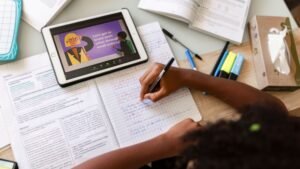
Yes — it is arguably the single best self-study tool available, with one caveat. It is excellent at showing you how a procedure works and at finding your gaps. It is weaker when you are stuck and don’t know why you are stuck, because there is nobody to look at your work and tell you which step your thinking went wrong at. Most self-studiers do fine with Khan Academy alone until they hit that wall, usually somewhere in algebra 2 or calculus.
How do you actually finish a self-study math course?
The completion rate on free online courses are famously low, and rarely about the course material. Three things make the difference:
- Fix the prerequisite first. Most people who stall in calculus stalled in algebra years earlier. Run a diagnostic before you start a course you think you need.
- Write, do not watch. Video feels productive and teaches very little on its own. The learning happens when you work problems with the video closed.
- Short and often beats long and rare. Three or four sessions a week of 45 minutes will take you further than one long weekend session.
When is a self-study course not enough?
Self-study works well when you are filling known gaps and you can tell whether your answer is right. It works badly when you are preparing for a graded exam on a deadline, when you have been stuck on the same topic for weeks, or when the problem is confidence rather than content. Those are the cases where a person has to look at your work.
That is what Fremont Math Hub does. Every class is capped at three students, online or in person in Fremont, so the tutor can actually see how each student is thinking. Prefer live guidance? See our tutoring options or check the fee structure.
Two topics deserve their own preparation rather than a general course: if you are working through calculus, start with our guide to learning calculus online. If you are preparing for the SAT, use our SAT math prep guide instead.

Frequently asked questions
Can you really learn math online for free?
Yes. Khan Academy, MIT OpenCourseWare, OpenStax, Paul’s Online Math Notes and Professor Leonard together cover arithmetic through university mathematics at no cost. Paying gets you credentials, a teacher or a better practice system — not better core content.
Which online math course is best for adults returning to math?
Khan Academy, starting further back than feels comfortable. Adults returning to math usually have scattered gaps rather than one missing topic, and the adaptive practice finds them faster than working linearly through a syllabus.
Do online math certificates matter?
For employers, rarely on their own — they carry weight as supporting evidence next to a degree or a portfolio. For self-studiers, their real value is as a deadline that makes you finish.
How long does it take to learn math online?
A single high-school topic takes a few weeks at three or four sessions per week. A full course such as algebra 2 or calculus typically takes three to six months of consistent study. Rebuilding a shaky foundation before that adds a month or two.
What is the best online math course for kids?
Khan Academy for curriculum practice, Brilliant for children who are bored rather than struggling, and Art of Problem Solving for those ready for competition maths. For children who need accountability, a small class works better than self-study — ours are capped at three students.